Picture a cool January evening in Julington Creek. You’ve spent weeks reading about home saunas. You’ve measured the corner of the patio twice. Then you sit in an infrared sauna for ten minutes, step into a traditional one right after, and realize they feel nothing alike.
That’s where most sauna shoppers end up. Both types are called saunas, and both make you sweat. Beyond that, they heat differently, warm up on different schedules and suit different routines.
Choose the one that doesn’t match how you like to relax and it gets used less than you planned. Then add Jacksonville’s humidity, summer storms and the indoor-or-outdoor question, and the decision gets harder.
This guide breaks it down. You’ll see how infrared, traditional and hybrid saunas work, what each one feels like, where they fit in a Northeast Florida home, and how to pair one with a cold plunge or hot tub. By the end, you’ll know which one to sit in first when you visit.
How Each Sauna Type Makes Its Heat
The real difference between an infrared and a traditional sauna is where the heat comes from. Everything else follows from that one design choice, from the number on the dial to how long you wait before stepping in. A hybrid sauna gives you both systems in one cabin, so it helps to look at each heat source on its own first.
Traditional Saunas: Hot Air, Hot Stones and Steam
A traditional sauna uses an electric heater topped with stones. The heater warms the air in the room, and that hot air warms you. Most traditional saunas run between 150 and 195°F.
The stones give a traditional sauna its character. Ladle a little water over them and you get a burst of steam (the Finns call it löyly) that makes the room feel hotter for a minute or two. You decide how dry or steamy each session is.
Because the whole room has to heat up, traditional saunas take longer to get ready. Plan on roughly 30 to 45 minutes, depending on the sauna’s size and the temperature outside.
Infrared Saunas: Warmth From the Panels Outward
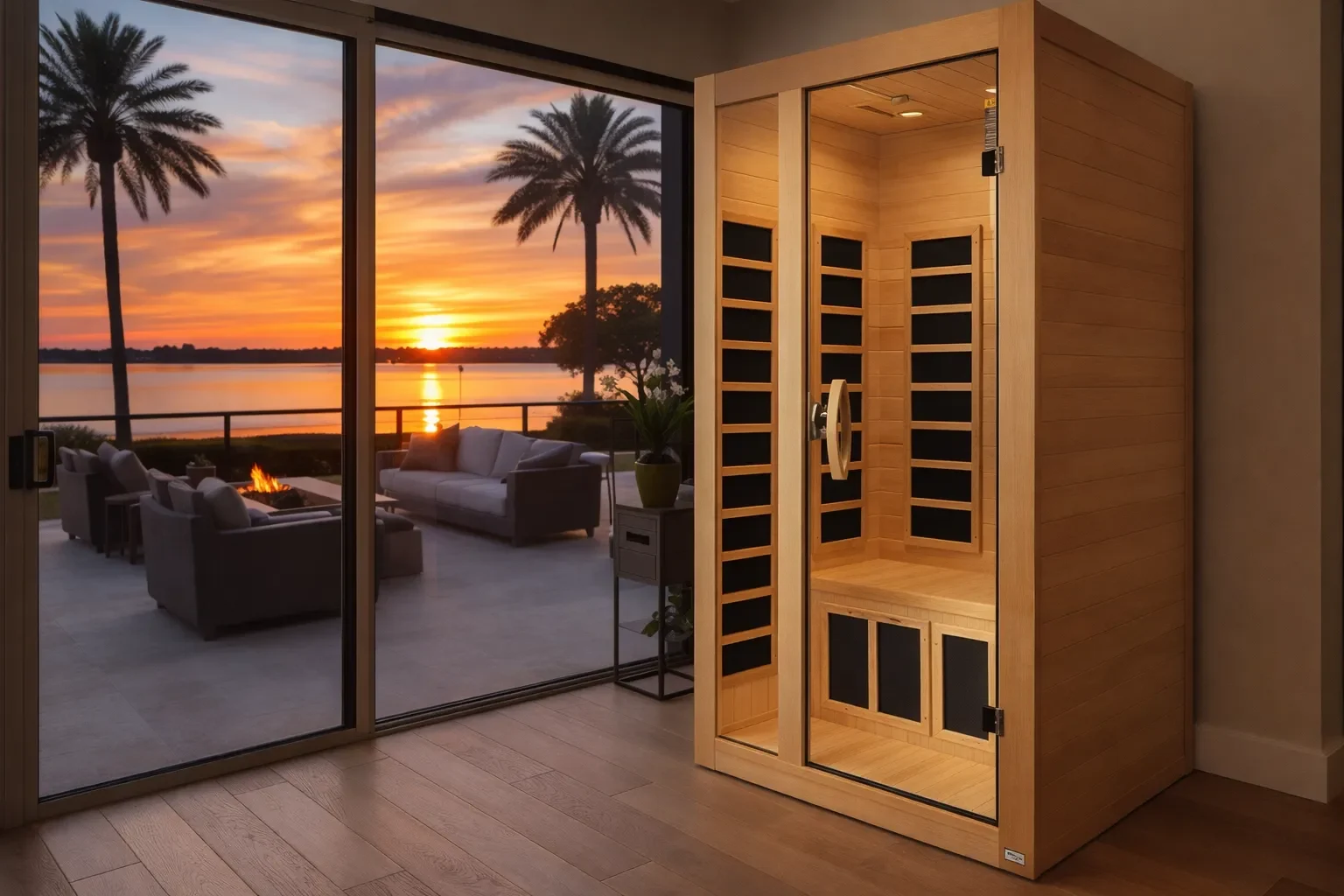
An infrared sauna uses heating panels, usually carbon or ceramic, mounted in the walls and sometimes under the bench. The panels give off infrared energy that warms your body directly. It’s similar to sitting in sunshine on a cool day, and the air around you stays milder.
Air temperature in an infrared sauna usually lands between 120 and 150°F. You still sweat, often plenty, but the room feels gentler. Most models are ready in 10 to 20 minutes.
You’ll see two common labels. Far infrared is the most popular type for home use. Full spectrum panels add near and mid infrared wavelengths. Several of the Maxxus models we carry also use near zero EMF heaters, a feature many shoppers ask about.

Hybrid Saunas: Both Heat Sources in One Cabin
A hybrid sauna pairs a traditional heater and stones with infrared panels. You can run either one alone or both together, depending on the session you want.
Hybrids suit homes where one person wants a hot, steamy round and another prefers lower, steady heat. Golden Designs hybrid models like the Visby and Karlstad are built for outdoor use, so the backyard can handle either style.
What a Session Feels Like in Each Sauna
Spec sheets only tell you part of the story. How the heat reaches you shapes the whole experience.
In a traditional sauna, the heat surrounds you. Your face and shoulders feel it first, and breathing warm air is part of the ritual. A splash on the stones turns up the intensity. Sessions tend to be shorter, often 10 to 20 minutes, followed by a cool-down and sometimes a second round.
In an infrared sauna, the warmth builds gradually. The air is comfortable enough to read, stretch or listen to a podcast, and many people stay 20 to 40 minutes. The sweat comes on slowly instead of all at once.
Neither one is the right answer for everyone. Some people love the strong heat and steam of a traditional room. Others want a calmer session they can fit in every day. The surest way to find out is to sit in both, and our showroom is set up for exactly that.
Matching a Sauna to Your Household and Routine
Once you know how each sauna feels, the choice usually comes down to how you’ll use it. These questions help sort it out:
- How much time do you have? If sauna time is a short window before work, the quick warm-up of an infrared sauna makes daily use easy.
- Do you want steam? If pouring water on hot stones sounds like the best part, go with a traditional or hybrid sauna.
- Who’s using it? Couples and solo users often love a 2 or 3 person infrared cabin. Families and friends who sauna together tend to pick a larger traditional model.
- How do you like to unwind? Quiet reading and long, easy sessions lean infrared. Short, hot rounds with a cool-down in between lean traditional.
Think about the calendar too. In Jacksonville, sauna weather peaks from late fall through early spring, when evenings cool off. In summer, most owners switch to early mornings or nights and keep sessions shorter.
If two people in your house want different things, that’s when a hybrid earns its spot.
Indoor or Outdoor: Placing a Sauna in a Jacksonville Home
Where the sauna goes can steer you toward one type or the other. Northeast Florida homes have good options on both sides of the back door, and each comes with its own planning points.
Outdoor Saunas and Florida Humidity
We hear this question a lot: does an outdoor sauna work in Florida humidity? Yes. When air is heated to sauna temperatures, its relative humidity drops sharply. A traditional sauna stays dry inside until you add water to the stones, even on a muggy evening.
Outdoor models are built for the weather, with weather-resistant roofing and Canadian hemlock or red cedar construction. Give the sauna a level base, some airflow underneath and a spot where roof runoff drains away from the door. A bit of afternoon shade helps the wood finish last longer in our sun.
Prepare for storm season the way you would for patio furniture or a grill. Follow the manufacturer’s anchoring guidance and keep the area around the sauna clear. Outdoor barrel and cabin saunas look great on a paver pad near the pool, next to a hot tub or tucked at the edge of the yard, whether you’re in Mandarin, Nocatee or Riverside.

Indoor Placement in a Garage, Spare Room or Home Gym
Infrared saunas fit naturally indoors. Many arrive as panel kits that go together in a few hours. They sit comfortably in a spare bedroom, a home gym or an air-conditioned garage bay.
Indoor traditional saunas work too. They need more planning for ventilation and a dedicated electrical circuit. Golden Designs offers indoor traditional models like the Copenhagen Edition and Hanko Edition for homeowners who want hot stones under their own roof.
Indoors, you get climate control and a short walk from the bedroom. Outdoors, you get a fresh-air cool-down between rounds. Both work well in Jacksonville, so the space you have usually decides it.
Barrel or Cabin: Choosing a Shape for Your Yard
Outdoor traditional saunas come in two main shapes. A barrel sauna is a round wooden cylinder laid on its side. A cabin sauna looks like a small room with square walls and a roof.
A barrel sauna has less empty space to heat, and its curved interior lets warm air circulate naturally from top to bottom. Plenty of homeowners also like the classic look next to a pool. Golden Designs barrel options include the St. Moritz for two, the Zurich and Arosa for four, and the Klosters for up to six.
A cabin sauna gives you more headroom, flat walls for windows and more flexible bench layouts. Models like the Kaskinen and Kaarina seat up to six adults, which makes them popular with families who sauna together.
If you’re torn between the two, think about the view. A glass-front cabin facing your backyard trees makes every session feel calmer.
A Closer Look at Golden Designs Saunas
Golden Designs saunas make up the full sauna lineup at Zen Outdoor. The family includes Maxxus and Dynamic infrared saunas, GD infrared models, indoor traditional saunas, and an outdoor traditional and hybrid collection. That covers every heat type in this guide, across dozens of models.
A few features show up across the lineup: Canadian hemlock and red cedar construction, low EMF heating panels on many infrared models, and controls that are easy to learn. These are the details most people look for when they read a Golden Designs sauna review.
When you compare models online, focus on four things: capacity, heater type, wood species, and whether the sauna is rated for indoor or outdoor use. Then come see your short list in person. Sitting on the bench tells you more about fit and comfort than any product photo.
Pairing a Sauna With a Cold Plunge or Hot Tub
A sauna on its own makes a great daily ritual. Pair it with cold water or warm jets, and it becomes the center of a full backyard wellness setup.
Contrast therapy, which means alternating heat and cold, has become one of the most talked-about wellness routines. A common pattern is a sauna round, a short cold plunge, then a few minutes of rest, repeated two or three times. Putting a cold plunge next to an outdoor sauna makes that routine easy to keep.
A hot tub works differently. Many owners use the sauna for heat, then finish with a slower soak and massage jets, especially on cool winter nights. If you’re curious about warm water, our post Hydrotherapy 101 covers how it helps the body unwind.
Start slow with any heat or cold routine and drink plenty of water. Check with your doctor first if you’re pregnant, have a heart condition or take medication that affects blood pressure.
Planning Your Sauna Installation
Whichever type you choose, a little planning makes delivery day simple. Here’s what to sort out ahead of time:
- Power: Many smaller infrared saunas plug into a standard 120V outlet on a dedicated circuit. Traditional heaters and larger units usually need a 240V circuit. Check each model’s spec sheet and hire a licensed electrician.
- Base: Outdoor saunas need a flat, solid, level surface, such as a concrete pad or pavers.
- Access: Measure gates, doorways and tight turns along the path to the install spot.
- Clearance: Leave room around the sauna for airflow, upkeep and a door that opens fully.
If you live in a planned community, check your HOA guidelines for backyard structures early. Many neighborhoods across Duval and St. Johns counties have their own rules.
Our team can walk you through each step when you visit. For ideas, browse our install gallery to see how other Jacksonville homeowners have set up their backyards.
Frequently Asked Questions
Is an infrared or traditional sauna better for beginners?
Many first-time owners find infrared easier to start with, thanks to its lower air temperature and quick warm-up. Others love the traditional experience from day one. Trying both in the showroom is the best way to decide.
Can I use an outdoor sauna in Jacksonville year-round?
Yes. Outdoor saunas are built for the weather, and the heated interior stays dry even in humid conditions. Most owners use theirs most from fall through spring and move summer sessions to mornings and evenings.
How hot does an infrared sauna get compared to a traditional sauna?
Infrared saunas usually run between 120 and 150°F. Traditional saunas typically run between 150 and 195°F. Infrared feels gentler because it warms your body more than the air around you.
Do I need an electrician to install a home sauna?
Yes. Even plug-in infrared models do best on a dedicated circuit, and traditional heaters usually need a 240V line. A licensed electrician makes sure everything meets code.
Can I use a sauna and a cold plunge on the same day?
Yes. That’s the idea behind contrast therapy. Keep cold plunges short, rest between rounds, and talk with your doctor first if you have any health concerns.
Where can I see Golden Designs saunas in Jacksonville?
Golden Designs saunas are on display at our Mandarin showroom on Oldfield Crossing Drive. You can sit in infrared and traditional models and compare them side by side.
Find Your Sauna at Our Mandarin Showroom
Reading about heat only gets you so far. The fastest way to know whether infrared or traditional suits you is to sit in both.
Our showroom is at 4193 Oldfield Crossing Dr., Suite 4, just inside I-295 off Old St. Augustine Road. Browse our saunas online first, then stop in to see sauna models, cold plunges and Jacuzzi® hot tubs set up side by side.
Call (904) 445-7616 or plan your visit, and we’ll help you find the sauna that fits your home and your routine.